
United States President Donald Trump has said that Iran is under close watch and a 'massive fleet' is heading towards the Gulf region.
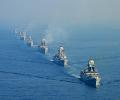
The Indian Navy will conduct a large-scale multilateral maritime engagement exercise with African countries in April, aiming to enhance interoperability with African navies and further strengthen maritime security cooperation. The exercise, titled "AIKEYME" (Africa-India Key Maritime Engagement), will see the participation of several African nations, including Comoros, Djibouti, Eritrea, Kenya, Madagascar, Mauritius, Mozambique, Seychelles, and South Africa. The exercise is part of India's growing engagement with the Global South, as outlined by Prime Minister Narendra Modi's "MAHASAGAR" vision for mutual and holistic advancement in the region.

Building relations in the Indian Ocean, New Delhi has gifted naval vessels to Mauritius, the Maldives and Sri Lanka, even as China eyes the same locales.

Indian and US armed forces conclude a comprehensive training phase as part of Exercise Tiger Triumph 2025.
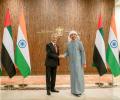
Frankly, was it really necessary in the middle of a fratricidal war for External Affairs Minister S Jaishankar to travel to Abu Dhabi for a one-on-one with the sheikh on April 12?Or, for National Security Advisor Ajit Doval to follow up on April 26? Or, for PM Narendra Modi to follow through today? There are no easy answers, notes Ambassador M K Bhadrakumar.

Amidst escalating regional tensions, Sri Lanka is carefully considering its response after a second Iranian ship requested entry into its waters following a reported US submarine attack on an Iranian frigate near Galle.

US President Donald Trump is considering ending the military operation against Iran even if the Strait of Hormuz remains closed, according to the Wall Street Journal.

Discover the only way to travel, where fun meets fitness!

The Islamic Revolutionary Guard Corps (IRGC) has declared the commencement of its 27th offensive under Operation True Promise 4, targeting American and Israeli positions in response to what it termed a new wave of 'unprovoked US-Israeli aggression against the Islamic Republic', Iranian state broadcaster Press TV reported.

They share their excitement :)

In their talks, Modi and Merz are likely to deliberate on trade and investment ties as New Delhi is looking at deepening economic engagement with Europe against the backdrop of Washington's 50 percent tariff on Indian goods, people familiar with the matter said.

Amidst rising tensions in the Middle East, an Iranian drone struck a British RAF base in Cyprus, prompting the UK to allow US defensive operations and consider evacuation plans for British citizens in the region.

Bihar's greatest resource is not beneath its soil but above it -- its people. With a population approaching 140 million and one of India's youngest demographic profiles, Bihar possesses an asset many societies would envy, explains Bihar Governor Lieutenant General Syed Ata Hasnain (retd).

A senior government official confirms that Indian vessels do not require permission to navigate the Strait of Hormuz, despite regional tensions. Several Indian ships, including LPG tankers, have safely crossed the strait, ensuring continued supply of essential commodities to India.

A senior US official has emphasised India's crucial role in maintaining peace and stability in the Indo-Pacific region and ensuring a balanced power dynamic in Asia, advocating for stronger defence ties between the two nations.

Ever since the Quad started taking shape in 2007, China has been saying that the four-member grouping will be bound to fail. But much to the chagrin of Beijing, it picked up pace in the recent years emerging as a premier strategic group especially challenging China's assertiveness in the disputed South China Sea.

In a region increasingly shaped by competition and coercion, such collaboration strengthens security without confrontation, builds capacity without dependency and promotes order without domination, points out Dr Kumar.

China's PLA Navy has deployed a number of platforms including frontline warships and a submarine for the exercise from November 11 to 17.
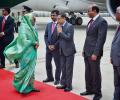
In addition to participating in the swearing-in ceremony, the leaders will attend a banquet hosted by President Droupadi Murmu at Rashtrapati Bhavan, it said.

The United States' historical strategic alignment with Pakistan, dating back to the Cold War, has consistently aimed to create a political and military parity with India, despite India's significantly larger size and resources. This long-standing relationship continues to influence regional dynamics, particularly in West Asia and the Indo-Pacific.

Minister of State for Defence Ajay Bhatt said in Lok Sabha the Navy deployed its units in the Gulf of Aden and East coast of Africa towards anti-piracy patrols since 2008 and a total of 3,440 ships and over 25,000 seafarers have been "safely escorted".

India's merchandise exports experienced a slight decrease in February, while imports surged due to increased gold and silver purchases, leading to a widened trade deficit. The West Asia crisis is expected to further impact trade in the coming months.

18 Indian-flagged vessels with 485 Indian seafarers still remain in the western Persian Gulf region
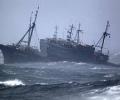
The Indian Navy's P8I maritime patrol aircraft on Thursday located a Chinese fishing vessel that capsized three days ago in the Indian Ocean, officials said.

India has commissioned its new indigenously-built nuclear-powered ballistic missile submarine INS Aridaman into service, further strengthening the naval component of its nuclear triad. Defence Minister Rajnath Singh also highlighted the Indian Navy's role in securing maritime trade routes.

The UK said the deployment of the carrier strike group marks the start of "a new era of defence cooperation with allies in India and the Indo-Pacific."

Four frontline warships of the Indian Navy participated in the 'PASSEX' exercise when the US carrier strike group was transiting through the Indian Ocean Region on its way from the South China Sea, the officials said.

The navy has significantly expanded its deployment in the Indian Ocean Region deploying a plethora of warships and submarines to create pressure points on China as the maritime space around the Malacca Strait is very critical for its supply chain through sea routes.

US President Donald Trump has indefinitely extended the ceasefire with Iran at the request of Pakistan, aiming to allow Tehran's leadership time to form a unified proposal to end the seven-week war.

"After more than 12 hours of intense coercive tactical measures as per the SOPs, the pirates on board the hijacked fishing vessel were forced to surrender. The crew, comprising 23 Pakistani nationals, have been safely rescued," the Indian Navy added.
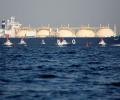
Analysts predict India will face oil price volatility and macroeconomic effects due to the escalating Iran crisis, though the country's oil supply chain is not yet structurally insecure.

INS Udaygiri and INS Himagiri marks the first occasion when two frontline surface combatants constructed at two different shipyards were commissioned simultaneously.

President Trump asserts the US military has decimated Iran's forces and no longer requires assistance from NATO allies to secure the Strait of Hormuz, despite earlier requests for support.

The United Kingdom on Tuesday posted a liaison officer at the Indian Navy's Information Fusion Centre (IFC) that has emerged as a key hub in tracking movements of ships and other developments in the Indian Ocean, a region witnessing increasing Chinese naval presence.
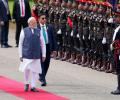
India's concerns over a planned naval exercise between Pakistan and Sri Lanka in the strategically important waters of Trincomalee led to the shelving of the drills weeks ago. The exercise was planned as part of regular engagements between the two navies, but India expressed its apprehensions to the Sri Lankan government. Trincomalee, situated on Sri Lanka's northeastern coast, is considered a significant hub in the Indian Ocean region, particularly for India's maritime security interests. The Pakistani Navy's close cooperation with China's PLA Navy has raised concerns in New Delhi about any Pakistani warship presence in Trincomalee. This incident follows previous diplomatic rows between India and Sri Lanka over the docking of Chinese vessels at Sri Lankan ports. India has been actively supporting Sri Lanka's development of Trincomalee's energy infrastructure and has recently signed a defense pact with the country to boost military cooperation.

The US blockade on Iranian ports is aimed to curb Iranian energy exports, thereby crippling its economy to force Iran back to the negotiating table, points out Commodore Venugopal Menon (retd).

The question is no longer whether the war will expand. It has. The next few days will tell us whether the war stabilises around Hormuz or whether the Strait itself becomes the trigger for a far larger rupture. What to watch for over the next 48 hours is simple: Any move by the US toward direct naval control of the Strait; any credible Iranian attempt to disrupt or mine shipping lanes and, critically, whether energy infrastructure in the Gulf continues to be targeted.If those lines are crossed in tandem, the war will no longer be containable within the region.

Prime Minister Narendra Modi and Maldivian President Mohamed Muizzu held talks focusing on trade, defence, and infrastructure cooperation, signaling a turnaround in relations after a period of strain.
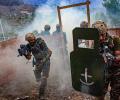
China on Monday signed a defence cooperation agreement with the Maldives to provide free military assistance to foster "stronger" bilateral ties with Male, weeks after President Mohamed Muizzu set a deadline for the withdrawal of the first group of Indian military personnel from his island nation.

'India is a top-tier security partner for Australia and we continue to prioritise practical and tangible cooperation that directly contributes to Indo-Pacific stability.'
